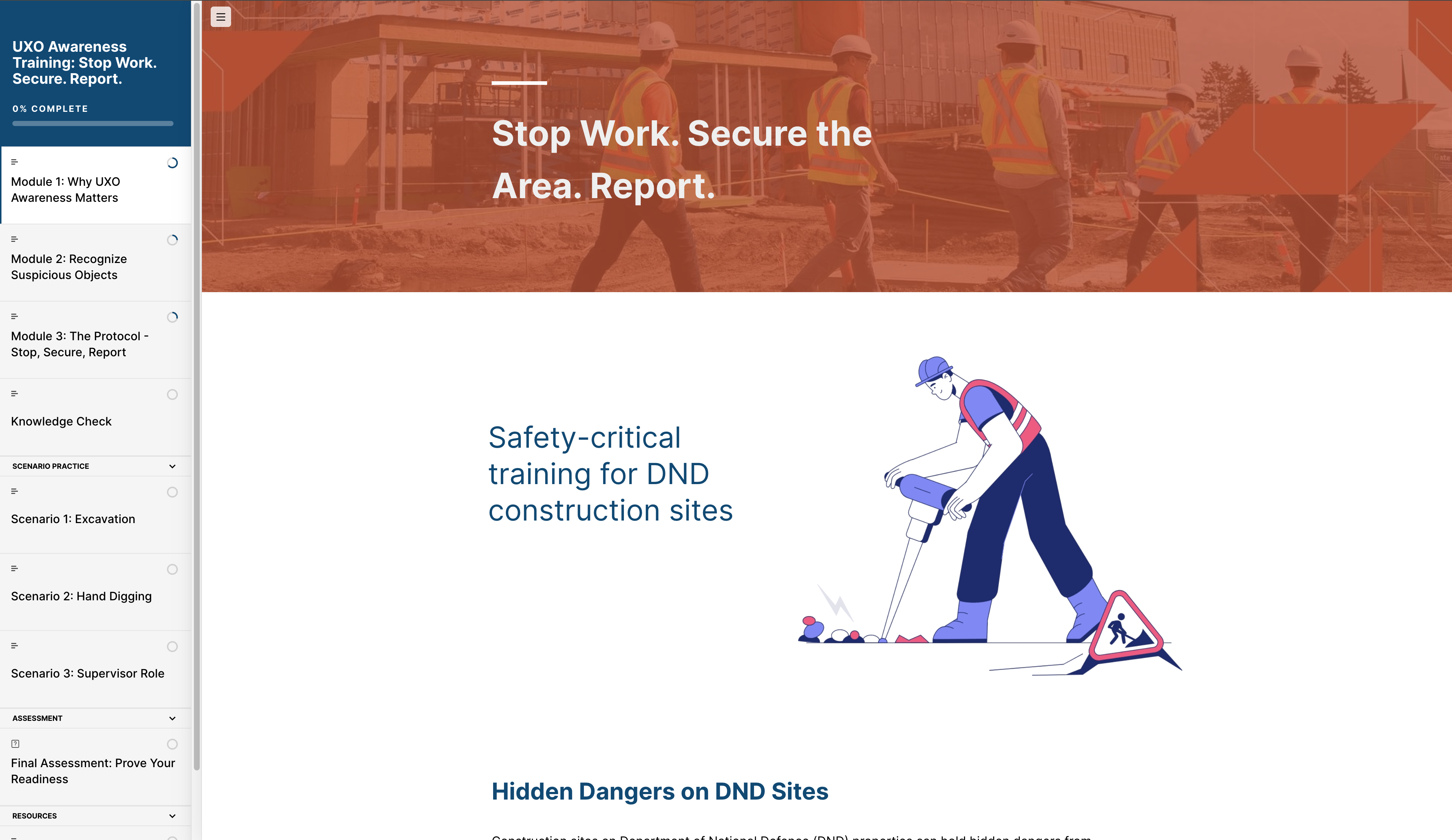
Designing safety-critical behavior change for mobile-first construction workers with a microlearning protocol that could save lives.
View Live Project
Overview
A federal government agency manages construction projects on Department of National Defence (DND) sites across Canada—properties with historical military activities that left unexploded ordnance (UXO) buried in the ground. When construction workers encounter suspicious objects during excavation, trenching, or demolition, their immediate response determines whether lives are saved or lost.
The project, titled "Stop Work. Secure the Area. Report." aimed to equip 500-1000 construction workers, equipment operators, and site supervisors with a life-saving 4-step protocol for UXO encounters.
The Challenge
This wasn't simply a knowledge recall challenge—it was a behavior change challenge in a safety-critical context. The training had to transform compliance-driven workers into confident protocol executors who would stop work immediately in high-stress situations, even when uncertain.
Performance Gap Analysis:
Current State:
Desired State:
Audience Challenges:
My Approach
I applied the ADDIE framework integrated with Merrill's First Principles, Gagné's Nine Events of Instruction, and Mayer's Multimedia Learning principles to ensure systematic, rigorous design.
Conducted performance gap analysis, audience context research, and stakeholder interviews. Confirmed training was the appropriate solution—the gap stemmed from knowledge and skill deficits, not system barriers. Identified mobile-first usage patterns (80%+ smartphone completion) and field constraints (outdoor lighting, work gloves, interruptions).
Designed assessment-first with 10 questions, five flagged as "critical" requiring 100% accuracy (life-safety actions). Applied Merrill's First Principles: opened with real excavation scenarios, not abstract concepts. Structured 5 microlearning modules (3-7 minutes each) to respect time and attention constraints.
Built in Articulate Rise 360 with branching scenarios, 90-second protocol demonstration video, and interactive elements. Applied Mayer's principles: color-coded steps, narration + visuals (not text duplication), removed decorative images. Developed laminated job aid as performance support tool for field use.
Ensured WCAG 2.1 AA compliance (color contrast ≥4.5:1, alt text, captions, keyboard navigation). Tested with work gloves, outdoor readability, and mobile optimization. Planned 4-week rollout: pilot with 50 users, revisions, then full deployment to 500-1000 workers.
The Solution
I designed a 5-module microlearning course (15-20 minutes total) that bridged training to real-world field application:
Module 1: Why This Matters (5 min)
Module 2: Recognize Suspicious Objects (3 min)
Module 3: The Protocol (7 min)
Module 4: Practice Scenarios (3 min)
Module 5: Assessment & Resources (2 min)
Design Decisions
Three key design decisions shaped the effectiveness of this training:
Traditional quiz-based training wouldn't achieve behavior change. Branching scenarios with consequence-based feedback (seeing explosion risk if you "continue digging") created emotional encoding that's far more memorable than reading "don't continue digging." The safe failure environment was pedagogically critical.
With 80%+ smartphone completion, I designed for mobile from the start: vertical scroll, large tap targets (≥44px), works with gloves (no hover interactions), optimized for 4G, offline-capable SCORM. This wasn't adaptation—it was the primary design paradigm.
Recognizing that training completion doesn't guarantee real-world protocol execution, I designed a laminated job aid as point-of-need performance support. Front: 4-step flowchart (visual, color-coded, minimal text). Back: Red flags checklist, prohibited actions, role-specific reporting chains, fillable emergency contacts. This bridged the training-to-performance gap.
Impact
Success was measured using the Kirkpatrick model to track reaction, learning, behavior, and business results:
Level 1: Reaction (Learner Satisfaction)
Level 2: Learning (Knowledge & Skill Acquisition)
Level 3: Behavior (On-the-Job Application)
Level 4: Results (Business Impact)
Reflection
This project reinforced that effective compliance training requires understanding the true performance context. The audience wasn't sitting at desks—they were in field environments with distractions, weather, and time pressure. Designing for that reality (mobile-first, offline-capable, job aid at point of need) was the difference between a course people complete and a system that changes behavior.
The assessment-first approach was critical. By designing the 10-question assessment before developing content, I ensured learning objectives drove instruction. The decision to require 100% accuracy on critical safety items (instead of just 80% overall) reinforced that safety-critical behaviors demand mastery, not partial competence.
If I were to iterate, I'd pilot the job aid earlier in development to gather field usability data before finalizing the laminated version. Testing outdoor readability, glove manipulation, and protocol lookup speed with real workers would have provided valuable insights for refinement.